
Lead Scripture — Proverbs 6:16-19
“There are six things the Lord hates, seven that are detestable to him: haughty eyes, a lying tongue, hands that shed innocent blood, a heart that devises wicked schemes, feet that are quick to rush into evil, a false witness who pours out lies, and a man who stirs up dissension among brothers.”
It’s mid-term season. You can feel it. I was sitting at the parent viewing room at my daughter’s cheer practice. I get a text message. I say under my breath, “I am so tired of political ads.” All of the sudden, 5 moms jump into the conversation. One common frustration — enough with the political texts. We can’t escape it.
Every time you pick up your phone, somebody is outraged about something. Every time you turn on the TV, somebody is yelling. Someone you know posted something on Facebook that made your blood pressure spike before you finished your coffee. A coworker shared an article with a headline so inflammatory you almost threw your phone across the break room.
We recently went to an event sponsored by the Poynter Institute. I had never heard of them before. They stand for Journalism, Truth, Democracy. My husband is a fan of Chuck Todd. Chuck has been affiliated with NBC and is now independent with his own podcast. He was getting an award for independent political journalism. During his acceptance speech, he said he draws a thru line of independence in journalism to 1994 — the OJ Simpson case. He said before that case, news sites were just told to not lose money. Once newsrooms covered it, they found that kind of event made money. Lots of MONEY.
How big was this case? A truck driver recently told me the furniture he was delivering reminded him of the O.J. Simpson trial. He was in fifth grade in 1994. His teacher put the trial on the classroom TV. Think about that — a case about a brutal murder, broadcast on cable television, shown to a room full of eleven-year-olds. He still remembers the shock. That’s how deep it reached.
Journalism changed, and now here we are — when to find out the truth about something, you have to go down a rabbit hole to where you feel like you are a Swiftie trying to decipher a Taylor Swift post. One person that fought covering that trial — Tim Russert. Oh, I loved Meet the Press with Tim Russert. According to Chuck, Tim only covered the end of the case. With the pressure he was getting, he didn’t cave. Chuck also got the question, what made Tim special. He said there wasn’t any big secret. Tim did all the research and was always prepared. Just hard work!
Now, you get to my cancer diagnosis. I am from the ruby red part of the state. Our lake cabin is in the slightly lighter shade of red. Where we live, Johnson County has become blue. And guess what — my friends and family in each of these areas showed up for me. Political views didn’t matter one bit. Kris did a sermon about what you’re paired to. Make sure you are listening to the right megaphone. We all can fall victim to listening to the “man who stirs up dissension among brothers.”
One of my favorite stories of my dad’s was when my grandfather passed. It was a sad day. Two great farmers in the community hit head to head on a gravel road. Likely, one of them was driving on the wrong side of the road checking out his fields. The alfalfa was in the ground. After the funeral, dad is looking around. He starts crying — how will I get this alfalfa out of the ground? It was ready and there was just him. Right then, he sees Alvy Beck coming down the hill with 10 more neighbors behind him. All the equipment he needed right there. What a community?! Fast forward 50 years to Lake Kahola — several lake cabins were hit this spring by a tornado. That weekend, I saw so many volunteers showing up to help! I believe that is why God put this on the list. He knew how important sacred community is. We can’t let conflict destroy it. Kris is adamant at church about no politics. I have been going for 6 years and have no idea her political beliefs. Occasionally during praises and prayers, a political prayer will be mentioned. We pray for all our politicians for wisdom. It is refreshing. No community division.
And here’s the thing — most of what I’m outraged about will never touch my daily life. Not my morning commute. Not my kid’s school. Not my dinner table. And I get furious about it anyway, because someone made sure I would be.
That’s not an accident. That’s a business model.
Proverbs 6 gives us a list of seven things God detests. Not dislikes. Not frowns upon. And the last item on the list, the one that gets the emphasis of being the seventh, is this: a man who stirs up dissension among brothers.
Think about that for a second. Stirring up conflict among people who should be united lands on the same list as shedding innocent blood. God takes this that seriously.
And I think the reason is that most sins on this list damage individuals. But stirring up conflict damages the whole body. It breaks trust. It turns neighbors into enemies. It makes people who agree on ninety percent of life go to war over the ten percent they don’t. It’s a multiplier. It makes everything else on the list worse.
Now look around.
We have entire industries built on doing exactly what Proverbs 6 calls detestable. Cable news figured out — in 1994, if you agree with Chuck Todd — that outrage gets better ratings than reporting. Social media figured out that angry posts get shared more than happy ones. Political campaigns figured out that fear drives more donations than hope. And all of it — every bit of it — runs on money.
Outrage and dissension is profitable. Peace is not.
The person on TV screaming about an issue that affects a fraction of a percent of the population isn’t trying to inform you. They’re trying to keep you watching through the commercial break. The algorithm that keeps showing you posts that make your jaw clench isn’t broken — it’s working exactly as designed. Your anger is the product. Your attention is what’s being sold.
And here’s the part that’s hard to hear: we can’t help but feed it.
Every app on your phone is watching what you do. Some of them are listening too — your weather app knows where you are, your keyboard knows what you type, and all of it feeds a profile that follows you everywhere. Every time you tap on a headline, you’re casting a vote. Every time you share a post — even to argue with it — you’re telling the algorithm, “Show me more like this.” Every time you spend an extra ten seconds reading a comment that made you angry, the system logs that as engagement.
The algorithm doesn’t know if you’re happy or furious. It doesn’t care. It just knows you stopped scrolling. And it will show you more of whatever made you stop.
So when millions of people rage-click on a story, the algorithm learns: outrage works. Serve more outrage. And the cycle spins faster.
But here’s what that also means: we can change it.
If the algorithm learns from what we click on, then we can teach it something different. If we stop clicking on the outrage, stop sharing the thing that made us mad, stop commenting on the post we disagree with — and instead start liking, sharing, and engaging with things that are good, encouraging, true, and helpful — the algorithm will follow.
It has to. That’s how it’s built.
We are not helpless consumers of whatever the machine serves us. We are training the machine with every tap of our thumb. The question is: what are we training it to do?
Two thousand years before anyone invented a news feed, Paul wrote this in Philippians 4:8:
“Finally, brothers and sisters, whatever is true, whatever is noble, whatever is right, whatever is pure, whatever is lovely, whatever is admirable — if anything is excellent or praiseworthy — think about such things.”
Read that list again. True. Noble. Right. Pure. Lovely. Admirable. Excellent. Praiseworthy.
Be a PLANTER.
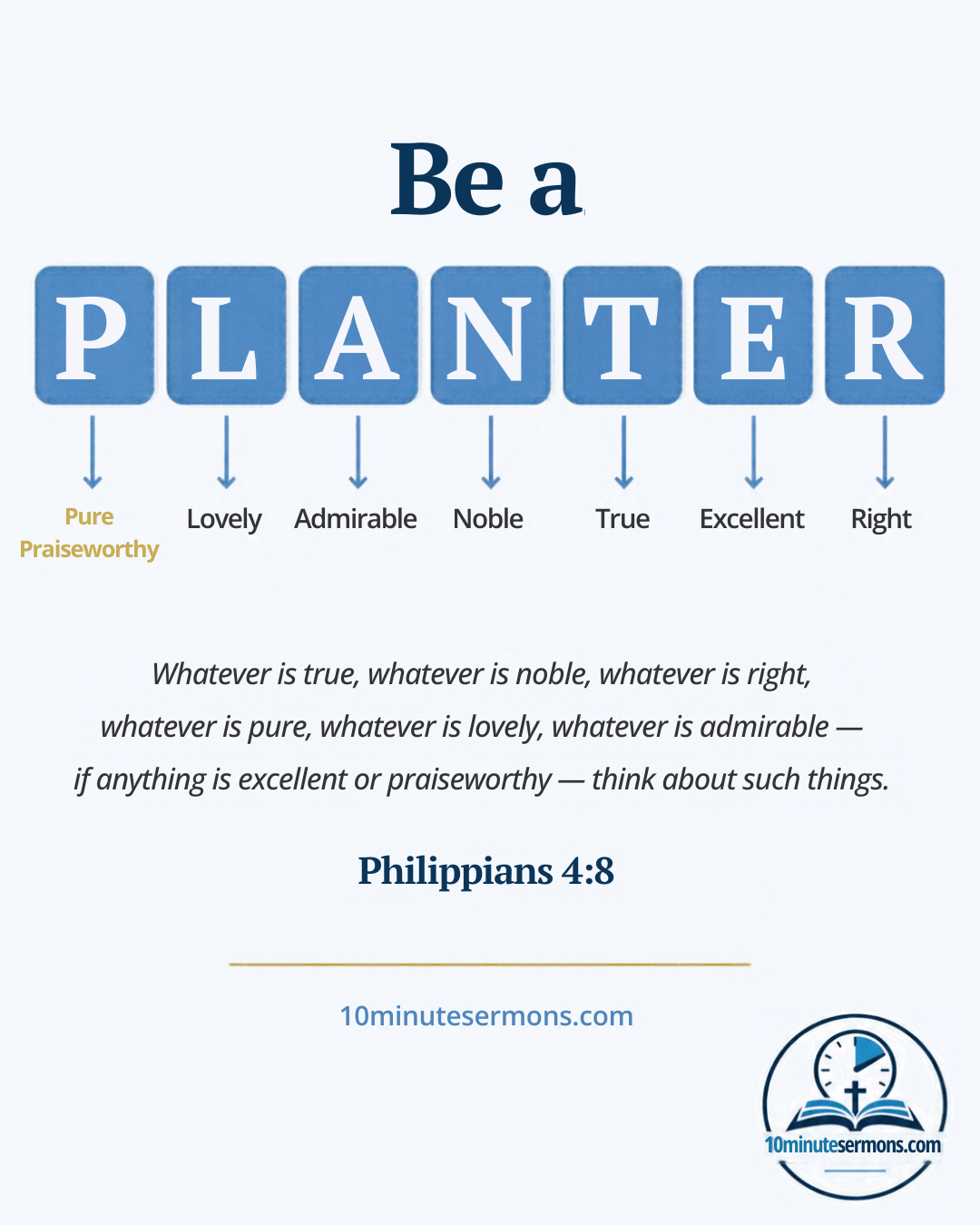
That’s not a suggestion. That’s an algorithm for your mind. Paul is telling you what to feed your attention to. He’s saying: you have a choice about what you dwell on. Make it deliberately.
Now, does that mean we ignore injustice? Of course not. Does it mean we never engage with hard topics? No. But there’s a difference between being informed and being consumed. There’s a difference between caring about something and doom-scrolling about it at midnight. There’s a difference between having a conviction and letting someone monetize your anger.
Proverbs 6 names the sin: stirring up conflict for gain.
The algorithm explains the mechanism: your clicks are the fuel.
Philippians 4 gives the solution: choose what you feed your mind.
So I’m trying something. For the next seven days — one for each thing God detests on that list — I’m not clicking on the headline that makes me angry. I’m scrolling past the post that makes me want to fire off a comment. If someone shares something designed to outrage me, I’m not resharing it — not even to say how wrong it is. Engagement is engagement. The algorithm doesn’t care about my motives.
Instead, I’m going to find something true and share it. Something lovely and comment on it. Something admirable and send it to a friend. Train the algorithm the way Paul would. Be a PLANTER!
I am going to ask myself before every like, click, or comment — is this Pure, Praiseworthy, Admirable, Noble, True, Excellent, or Right? If so, I will engage!
If you try it too, I think we’ll be surprised at what happens. Our feeds will start to change. Our blood pressure might too.
We can’t control what the networks broadcast. We can’t control what the politicians say. We can’t control what your friend posts. But we can control what we click on. And if enough of us do that — if enough of us stop feeding the machine — the machine has to change.
Because it follows us. It always has.
“Do not conform to the pattern of this world, but be transformed by the renewing of your mind.”
— Romans 12:2
And just a few verses later, Paul tells us we’ve each been given gifts — prophesying, serving, teaching, encouraging, giving, leading, showing mercy. Not the same gift. Different gifts, on purpose. I wrote more about that in Yes, And — the idea that your gift isn’t an accident, and neither is someone else’s. As someone with the gift of encouragement, I feel like part of my job is to encourage you to use yours. So here’s me doing that. Whatever your gift is — use it. The algorithm of outrage doesn’t stand a chance against a community actually using what God gave them.
Change your mind. Change your feed. Change the algorithm. Be a PLANTER.
My Prayer
Lord, forgive us for the times we’ve fed the fire instead of starving it. Forgive us for the rage-clicks and the hate-shares and the arguments we started at midnight that helped no one — not even ourselves. We confess that we’ve let other people’s outrage become our own, and we’ve made money for people who profit from our division. Give us the discipline to scroll past the bait. Give us the wisdom to know the difference between being informed and being manipulated. Remind us that our attention is sacred — that what we dwell on shapes who we become. Please help us to remember this list and to be a PLANTER — to choose what is pure, lovely, admirable, noble, true, excellent, right, and praiseworthy. Not because the world isn’t broken. But because You’re asking us to stop making it worse. Change our hearts, Lord. And let it start with what we click on. Amen.
Share this sermon: 10minutesermons.com/change-the-algorithm If this spoke to you, it will speak to someone you know. Send it to them.
For another sermon inspired by the parent viewing room at cheer practice, check out Accept the Correction and Move On.